
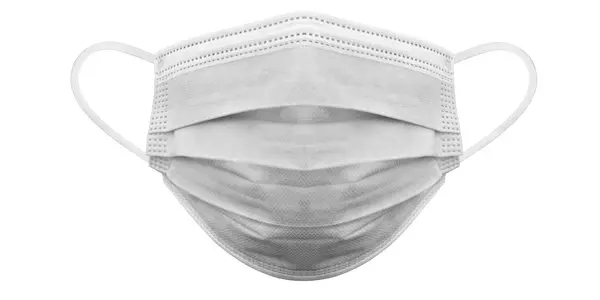
Governments around the world are enforcing facial coverings to prevent SARS-Cov-2 infection, but does the science support their use?

s of two days ago, Boris Johnson’s government announced it will henceforth be illegal to use public transportation in the UK, without wearing a mask.
This goes along with many other governments – both local and national – which have enforced mandatory mask-wearing to one extent or another.
Leaving aside the question of whether such steps are necessary to combat a virus they openly admit is harmless to the vast majority of people – the question becomes: Do masks actually do anything to prevent the spread of this disease? Or respiratory diseases in general?
Well, some mask manufacturers don’t seem to think so. Printing this warning on the side of the box:

But, in case that’s just a company seeking to prevent liability, maybe we should look at some proper scientific research on the subject. There’s quite a bit of it.
Most of the media and politicians are strident in their support of enforced mask-wearing, but the science supporting that is thin on the ground.
While the Lancet and Mayo Clinic have produced articles recommending mask use, actual scientific studies are hard to come by.
The only evidence-based review I was able to find is forced to use very soft language in its conclusions. Titled [my emphasis] “Cloth Masks May Prevent Transmission of COVID-19″, it openly admits [again, my emphasis]:
Although no direct evidence indicates that cloth masks are effective in reducing transmission of SARS-CoV-2, the evidence that they reduce contamination of air and surfaces is convincing.
Other, purportedly scientific, publications have reduced themselves to publishing alarmist, unscientific, non-factual arguments that source the Los Angeles Times in place of any research, statistics or peer-reviewed papers.
The lack of hard science backing the government’s position on masks is evidently a concern in the propaganda networks, because they produce articles like this one in today’s Guardian:
We can’t be 100% sure face masks work – but that shouldn’t stop us wearing them
Which tries to turn it from a fact-based consideration into an ethical argument (A very common tactic among people who know they would lose an evidence-based debate):
this debate is as much about values as facts.
Despite the narrative push in favour of masks, the science is far from settled. With many papers – notably those pre-dating the Covid19 outbreak – suggesting masks do little-to-nothing to prevent the spread of viral respiratory infections.
A review of several mask-related papers, entitled “Why Face Masks Don’t Work” and conducted in 2016, found that [my emphasis]:
Between 2004 and 2016 at least a dozen research or review articles have been published on the inadequacies of face masks. All agree that the poor facial fit and limited filtration characteristics of face masks make them unable to prevent the wearer inhaling airborne particles. In their well-referenced 2011 article on respiratory protection for healthcare workers, Drs. Harriman and Brosseau conclude that, “facemasks will not protect against the inhalation of aerosols.”
Read More – Coronavirus Fact-Check #6: Does wearing a mask do anything? [Article From 6/6/20]

![Former Australian Senator Claims “Great Reset” is Real Agenda Behind COVID Panic [Article From 14/10/20]](https://covidcon.co.uk/wp-content/uploads/2026/07/image-4.png)
![The Great Reset: The end of Capitalism [freedom] as we know it [Exactly what I have been saying for 30 years to the sound of laughter and media ridicule] [Article From 11/1/21]](https://covidcon.co.uk/wp-content/uploads/2026/08/image-1.png)
![Covid’s Covert Reengineering of Humanity [Article From 14/12/20]](https://covidcon.co.uk/wp-content/uploads/2026/06/17822123076593453898175364174905.jpg)
Leave a Reply